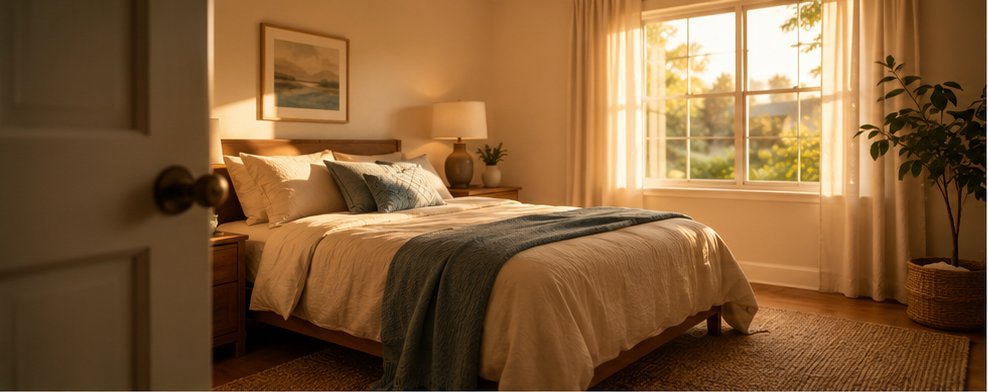
The room used to have a name. "Danny's room," you'd say, even years after Danny moved to Denver and started a life of his own. These days it mostly just has a door that stays closed. You've thought about renting it out more than once. Then you picture a stranger's coat on the hook by the door, a stranger's dishes in your sink — and the thought quietly closes the door behind it, the same way it always does.
That instinct isn't foolish, and it's worth saying plainly: this isn't right for everyone. Some retirees try it and discover the company is worth as much as the check. Others try it and discover that losing the quiet of an empty house costs more than they expected, no matter how nice the person turned out to be. Both of those are honest outcomes. Neither one means you did it wrong.
One couple describe it as having "auditioned" three people over six months before anyone actually moved in. Two didn't feel right within a week of talking, and they said so, plainly, and that was that. By the time someone did stay, it wasn't a leap of faith. It was closer to signing off on something they'd already tested.
What tends to make it worth it
People who end up glad they did it tend to share a few habits, more than luck: clear expectations from day one — who uses the kitchen when, what "quiet after 9" actually means in practice — a platform built for matching and screening rather than word of mouth alone, and a trial period treated as genuinely temporary, not a formality on the way to something permanent.
What tends to make it not worth it
The regrets tend to trace back to the same few shortcuts: skipping screening because someone "seemed nice" over coffee, not talking through what "shared kitchen" means until the first Tuesday it didn't work, or assuming from the start that this had to be permanent rather than something either side could end after a season without hard feelings.
What a room actually tends to bring in
Skip the national number. Look at your own zip code — five minutes on Zillow or SpareRoom will tell you more than any average ever could. As a starting point: SpareRoom's 2024 data across the 20 largest U.S. metro areas found room-renting retirees — sometimes called "live-in landlords" — typically earn between $900 and $1,600 a month, depending on the city. New York City runs toward the top of that range; a city like Atlanta tends to land closer to the bottom. Your own listings, not this paragraph, are the number worth trusting.
What it actually feels like, month to month
The parts nobody mentions until later: the different smell of coffee some mornings. Learning someone else's routine well enough to half-predict it — the creak of the third stair around 6:30, the TV volume two clicks louder than you'd choose. And the specific, quiet relief of a check that covers something real, not because it's dramatic, but because it's ordinary in a good way — an odd sort of normal that, eventually, just becomes normal.
Some people describe getting used to it in a matter of weeks. For others, it took longer. A few never quite did.
That last group isn't a cautionary tale. It's just an honest answer some people get, and it's one worth respecting rather than pushing past.
A few practical things people forget
Check with your homeowner's insurance before anyone moves in — some policies have opinions about long-term guests that are cheap to sort out in advance and expensive to sort out after. A simple written agreement, even a page long, saves both people from relying on memory later about what was actually promised. And any income here is taxable, so a short conversation with whoever does your taxes is worth having before the first check arrives, not after.
The practical middle ground
If you're on the fence, don't decide forever in one sitting. A 30-day trial through a platform that handles the screening for you is the specific, lowest-risk way to find out — not a leap, just a look.
A few questions worth asking before anyone signs anything
Beyond the standard background check, a short conversation tells you more than any application ever will: What does a typical weeknight look like for you? Do you work from home, or keep unusual hours? Is there anyone else — a partner, a pet — who'd be staying too? None of these have a right answer. They just help you picture the actual person who'd be living down the hall, rather than the idea of a tenant on paper.
The first thirty days
Almost everyone describes the same arc, and knowing it in advance takes some of the sting out of it.
The first week is polite and slightly stiff. Both of you are on your best behaviour and the house feels a little like a hotel you happen to own. Somewhere in the second or third week the politeness wears off and the real friction shows up — usually something small and domestic, dishes or the television or what time the front door opens. That's not the arrangement failing. That's the arrangement becoming real, and it's the point at which the house rules you wrote down stop being paperwork and start earning their keep.
By week five or six most people report that they've stopped noticing. Not that they love it — just that it's become ordinary. The ones for whom it never becomes ordinary usually know by then too, which is exactly what a trial period is for.
What to say when someone asks why
Eventually, someone will ask — a sibling, an adult child, a neighbor who noticed a new car in the driveway. It helps to have an honest answer ready that isn't defensive: "It made sense for the house and for the budget, and I tried it before I committed to it." That's usually enough. The people who love you mostly want to know you thought it through, not that you asked their permission first. Most conversations end there, and most people move on to asking how it's going instead.